Work Sucks, I Know
Long hours, stagnant wages, and no voice at the table - Britain's biggest companies are failing the people who keep them running.

This week’s guest post is from Paddy Goffey, head of research and policy at the High Pay Centre, an organisation dedicated to fairer pay structures, stronger worker voice and a more responsible business model. Follow the High Pay Centre, and support their valuable work here.
The average person will spend over 80,000 hours working over the course of their lives. That works out at around a decade of non-stop work.
But work doesn’t just take up a lot of our time – it has a huge impact on our health and wellbeing. The average British worker will spend over 13,000 hours commuting, take more than 3 months off sick, and involve themselves in more than 800 workplace arguments.
Work should provide us with the means to enjoy a comfortable standard of living, and allow us to feel fulfilled, healthy and happy. But recent data found that just 11% of UK workers feel engaged in their jobs. This dissatisfaction plays a significant role in the wider social and economic challenges we face – from falling living standards, to rising loneliness, and worsening mental health.
The large companies that dominate the modern working environment appear reluctant to acknowledge and confront the costs of work. Data published last week by the High Pay Centre reveals that few large firms make meaningful attempts to engage with their employees or seek to understand their needs and interests. For example, no FTSE 100 company has yet appointed a worker director to its board; and only 12% of firms meaningfully consult staff on executive pay. Just 55% of the largest firms in the country commit to paying their employees a living wage.
Too many companies demand their employees work long hours for low wages, while failing to give them a say in the way the organization works. Should it really come as such a shock that so many workers feel disengaged?
The CSR Mirage
When firms fail to consult and engage their employees, internal inequality rises. The High Pay Centre has found that average CEO pay is up 33% since 2023 to £6.02 million; and a CEO’s typical pay package rose from 93 times that of their median employee to 100 times in the same period.
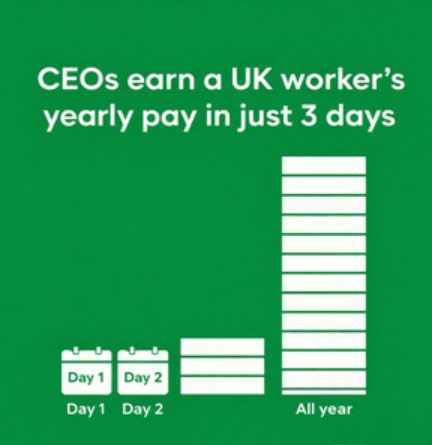
A company that truly took the time to understand their employees, what motivates them, and what makes them more productive, would not consider this growth in CEO pay an effective use of resources. There is little evidence that better-paid CEOs deliver better outcomes for workers, or the business as a whole.
Most firms like to claim that they treat their workers well – and that they’re responsible corporate citizens. Annual reports are rife with empty platitudes and weakly evidenced self-praise. Yet reality couldn’t be further from this fantasy: the average Brit will consider quitting their job sixteen times a year.
The harsh truth is that, for the typical employee, all the talk about CSR and ESG has made very little difference to their working lives. In fact, there is an argument that the rise of these discourses has mirrored a broader societal shift towards effectively marketed aesthetics and virtue-signaling over genuine change.
We are too willing to allow any business that claims to act in the best interests of workers and society to call itself a ‘good employer’. In fact, the evidence suggests that a company can enhance its reputation or boost its profits without providing any meaningful improvements for employees.
From Platitudes to Power
It is clear that, for the most part, companies are unlikely to alter their behaviour solely out of goodwill. This is where government must be aggressive in shifting companies away from a narrow focus on shareholder returns. Standards like living wage accreditation, reasonable pension provision and worker share ownership must be treated as non-negotiables – in the same way as returns to shareholders are now.
But delivering on these promises also requires rebuilding worker power. History has consistently demonstrated that, when firms conveniently forget that their prosperity rests on human labour, workers will find a way to remind them of that fact. Companies would be wise to recognise this when considering whether to increase CEO pay while forcing workers to accept real terms pay cuts.
An assertive union movement remains an indispensable tool in creating a fairer world. Rebalancing the power of capital and labour in this way will take time, as well as careful policy development and political organizing. But for as long as we continue to live in a system predicated on power imbalances and weak accountability, work will continue to fail to meet the needs of those who perform it.
Follow the High Pay Centre, and support their valuable work here.
 | A guest post by
|
“She left me roses by the stairs.
Surprises let me know she cares” :-)
This is key, and yet I struggle with how labor should be organized. Should it be by industry? Salary? It seems to me that a focus on shifting taxes on to capital (especially land) in order to tax labor as little as possible might help create a long-lasting political coalition
One thing I think is missing from discussions like this is the long shadow of deindustrialisation and the collapse of apprenticeship culture.
We often talk about bad jobs as if the problem is only low wages, long hours, or poor management. But Britain also dismantled huge parts of the economy that once gave materially-minded people meaningful roles in society.
Not everyone experiences the world primarily through abstract or academic work. Many people think through doing, making, repairing, adjusting, observing. Historically those people became engineers, machinists, builders, mechanics, framebuilders, toolmakers and skilled tradespeople through apprenticeships and workshop culture.
Now many of those pathways barely exist, especially for young working-class people. So a lot of practical intelligence is either redirected into low-status work or written off altogether.
The old workshops didn’t just produce bicycles or machinery. They produced judgement, confidence, responsibility, and belonging. People learned by participating in real work alongside skilled adults.
I think we need a much bigger reckoning with what deindustrialisation actually destroyed culturally and psychologically, not just economically.