Why Venezuela? Why Now?
Trump might have more in common with Maduro than he thought.

Why Venezuela?
Oil. We all know its oil because Trump has told us so. A few months ago, he tried to make a deal with Maduro to ease the sanctions on Venezuela. In exchange, Trump demanded that Venezuela stop exporting oil to China and instead allow American companies into the country to exploit its plentiful reserves – the largest untapped oil reserves in the world.
He also explained very clearly that the capture of Maduro was motivated by oil. “We’re in the oil business,” Trump told reporters in the immediate aftermath of the invasion. US oil companies would, Trump said, go into Venezuela and “spend billions of dollars” exploiting the country’s oil reserves and fixing its broken infrastructure.
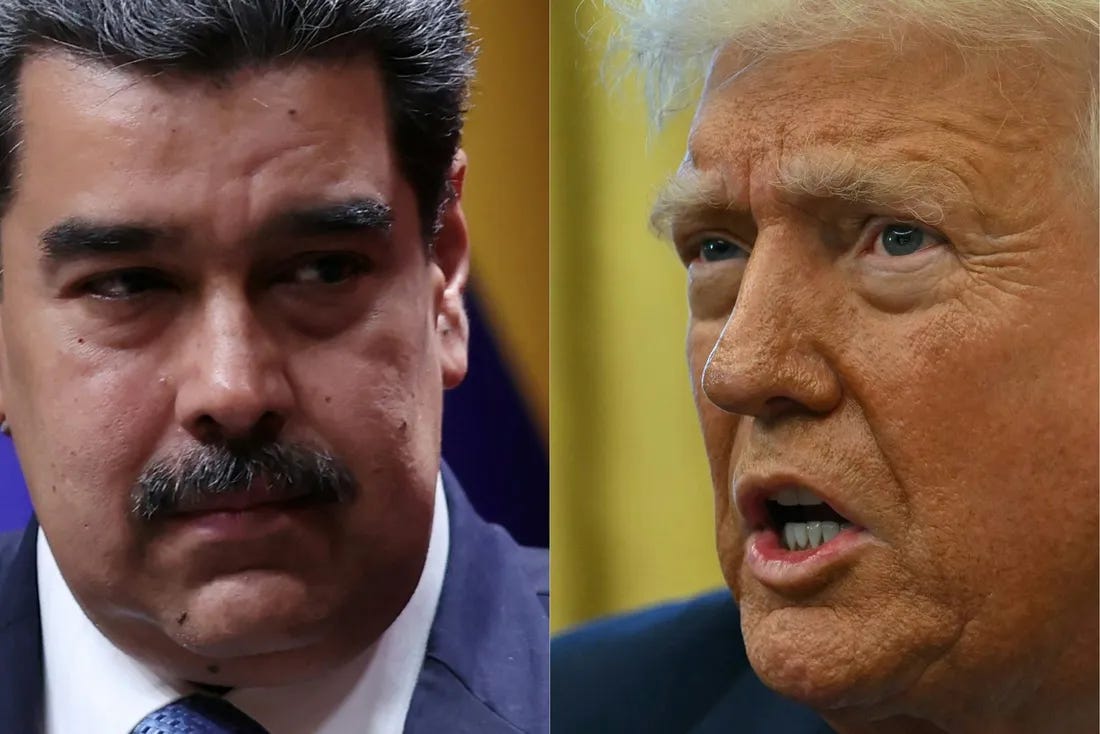
In true Trump fashion, he also said that the oil companies would be “reimbursed” for their efforts. In other words, the invasion is corporate welfare by other means. Trump is writing a giant cheque to some of the largest and most powerful companies in the world, backed up by the force of the American military. It would be hard to find a more perfect encapsulation of the Marxist theory of monopoly capitalist imperialism if you tried[1].
Why now?
Affordability is Trump’s Achilles heel. He can lie about almost anything else, because most of his rhetoric is of purely symbolic value to his supporters. It gratifies many Trump voters to hear the President bashing migrants and trans people, regardless of the policies he actually adopts.
But affordability is different. Everyone knows when they can’t afford to make ends meet – they feel it as hunger from skipped meals, cold from unheated homes, and fear they might not make the rent. Trump cannot avoid the fact that millions of his voters are struggling to get by under his leadership. Many of them feel deeply betrayed by the man who promised he would protect them.
Energy costs are an important and very visible factor in the affordability crisis. Americans see how much fuel is costing them every time they fill up their cars and every time they pay their heating bills. Trump knows this – and he’s been talking about bringing down oil prices for a long time now.
Up to now, his ‘drill baby, drill’ mantra has been the main foundation of this strategy. Thanks to the fracking revolution, the US has become the world’s largest natural gas exporter in recent years. But Trump’s plan to bring down energy prices by expanding US output contains a profound contradiction: falling oil prices are bad for US fossil fuel producers.
Economic sovereignty and energy independence
Fracking in the US is expensive, so it’s only viable when oil prices are relatively high. For fracking companies to break even, oil prices have to be around $65 per barrel. Thanks to an economic slowdown that seems to be hitting every sector of the economy except those linked to AI, oil prices have been falling. They’ve been below the break-even mark for a while now, and many fracking companies are cutting back investment and abandoning their rigs. Production is expected to fall further this year.
So far so good for Trump’s plan. But it’s not enough for oil prices to be falling – the US has to have energy independence too. Trump is the king of autarky – a devout economic nationalist – and having control over his own oil is a strategic imperative. It’s matter of economic sovereignty. For Trump, economic sovereignty is zero-sum. The more the US has, the less its enemies have – and vice versa.
If US shale production dries up because it’s no longer profitable, the US will lose its energy independence. To make matters worse, China is gaining energy independence just as the US is losing it. US sanctions have allowed the US’ number one enemy, China, to purchase oil from Russia on the cheap. And just as the US fracking revolution hits a wall, China is getting in on the fracking game too.
China has the largest shale gas reserves in the world, and it has been trying to exploit them since 2012. It’s expensive and challenging, but Chinese central planners know energy independence is of significant strategic importance, so will continue to divert resources into fracking, even if its loss-making. Meanwhile, US shale producers will start going under.
What’s the plan?
Trump knows he needs to act on affordability. He also knows that his job is to protect the interests of capital while securing the support of his working-class base. He needed a symbolic gesture towards dealing with the affordability crisis – one that makes people think he is trying to improve living standards, without constraining profits or raising wages, and which secures the US’ economic sovereignty.
Invading Venezuela was the perfect Trumpian response to the affordability crisis. It allows him to show American voters that he is acting to reduce their bills and make their lives easier, without raising wages or taking on the monopolies raising prices. In fact, it allows him to provide massive handouts to the fossil fuel companies. What’s more, the move ensures strategic control over the world’s largest proven oil reserves – and excludes enemy states from accessing them. In Trump’s books, that’s a win-win.
Why else would he have been so blatant about his intentions if not to demonstrate to the American people that this invasion was for them? It’s rare to see a US President so flagrantly breaking international law without even attempting to reach for a justification – whether ‘protecting democracy’ or ‘self-defence’. Trump has said, outright, that the US has invaded a sovereign country and abducted its leader in order to exploit its oil reserves. He has said this because he needs Americans to know that he has done it for the oil.
Will it work?
The economics of this argument is, of course, very confused. Even if US fossil fuel companies did end up investing in Venezuela and exploiting large amounts of its oil – which remains quite unlikely – the impact wouldn’t be felt for years. If the increase in supply was really significant, it might help to bring down prices in the medium term. But there are so many other factors affecting oil prices that they might end up going in the other direction.
The big factor affecting oil prices right now is falling demand. Outside of the AI boom, the US economy is not looking all that healthy. China is struggling with deflation and overproduction. European growth is anaemic. And no one expects things to get much better – in fact, most people expect things to get a lot worse. A global recession would mean a very sharp fall in oil prices. This might bring down bills, but it would also mean mass joblessness – a spectre made all the more real by the threat of AI-induced job losses.
In the medium term, if oil prices to fall this low, it would mean the end of the US shale boom. China would likely continue to subsidise its own shale producers. In the long term, if it could overcome the significant hurdles facing its own fracking industry, it might even take the fracking crown from the US. The US would be left without its own energy resources, while China neared energy independence.
In this scenario, Trump could try to coax US fossil fuel producers into exploiting Venezuelan oil to give him his own reserves – but with prices so low, they’d be unlikely to write any cheques. His only option would be to nationalise them for the sake of national security, like he did with Intel. Trump might end up having a lot more in common with Nicholas Maduro than anyone thought.
[1] See chapter 7 of Vulture Capitalism for a full discussion of Marxist theories of imperialism.
Gang warfare…organised crime is now running most of the world and crime boss warlords are will look to take each other out. Trump has no idea what he is starting but he will take out Cuba then Panama and keep threating Greenland unless America wakes up and throws him in jail. Oh and don’t mention the Epstein files while this catastrophe plays out.
Meet the new boss... ;)