What I Read this Week
Inequality, financial instability, and the coming crisis...

Articles
Gulf between rich and poor risks US downturn, Fed officials warn – The Financial Times
Central bankers are finally realising that massive inequality might be a problem when it comes to setting monetary policy. One of the officials quoted in this article admitted that there’s a good deal of evidence that “many families are living month to month”, while wealthy Americans benefit from a stock market boom.
Here’s the problem: the only method central bankers have to tackle inflation is raising interest rates. This mechanism works by raising the cost of borrowing, which slows down the economy, increases unemployment, pushes down wages and then, eventually, allegedly reduces upward pressure on prices. This process harms poor households more than rich ones – both because these households are more likely to lose their jobs and see their wages fall than those at the higher end of the income spectrum, and because higher borrowing costs put more pressure on their living standards.
Too much inequality makes this distributive problem even stickier. If rich people go out and spend lots of money, this can push up prices for everyone, creating pressure to raise interest rates. There’s also a concern about interest rates and bubbles – if interest rates are low during the upswing of the financial cycle, this can encourage reckless borrowing which feeds the bubble (exactly what’s happening now). But if lots of people are already unemployed and wages are already stagnant, raising interest rates could exacerbate the problem and potentially lead to a recession.
Basically, central bankers are stuck between a rock and a hard place. The issue, as I have written many times before, is that monetary policy is political – yet its decided by a bunch of unelected technocrats. Decisions about our public monetary system should be decided democratically, so that all these redistributive questions can be debated in the open, rather than behind closed doors in the halls of power.
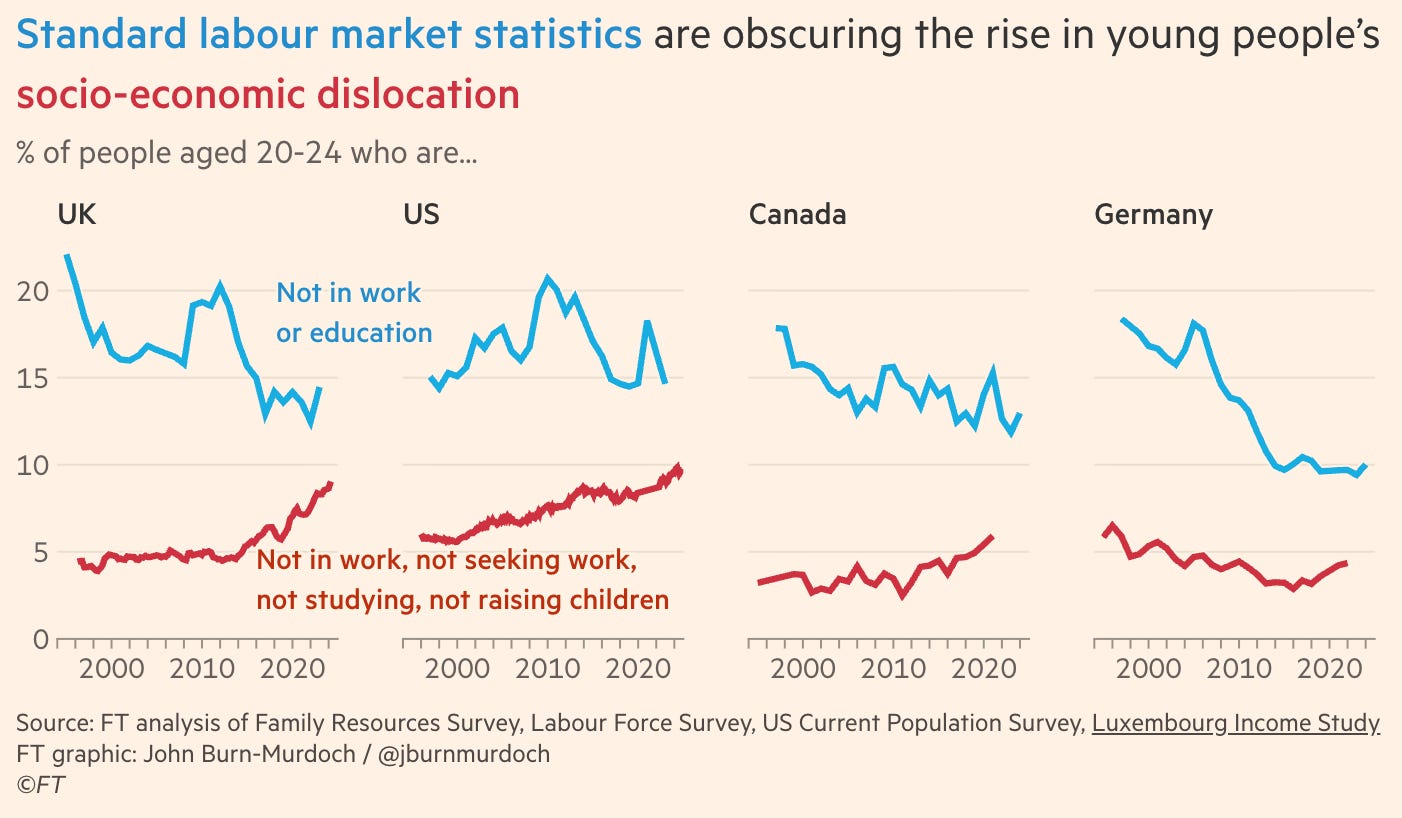
Young adults are growing increasingly economically dislocated – The Financial Times
This is a fascinating article showing that the proportion of young people not in work, seeking work, studying, or raising children, has been rising across many advanced economies. The problem is particularly severe in the US and the UK – in the UK, the proportion of young people in this group has doubled over the last decade – but the piece also shows a similar trend for Canada and Germany.