
Today’s guest post is from C. G. Beck, an architect and the author of The Labor of Architecture. He also works as an organizer and educator in New York City. You can find his newsletter, The Worst Architect, here.
In the common imagination, creative industries are those associated with the arts and design - think fashion, video games, graphics, and architecture. But this narrow definition of creativity hides the fact that all workers who produce something, whether physical or not, are creative.
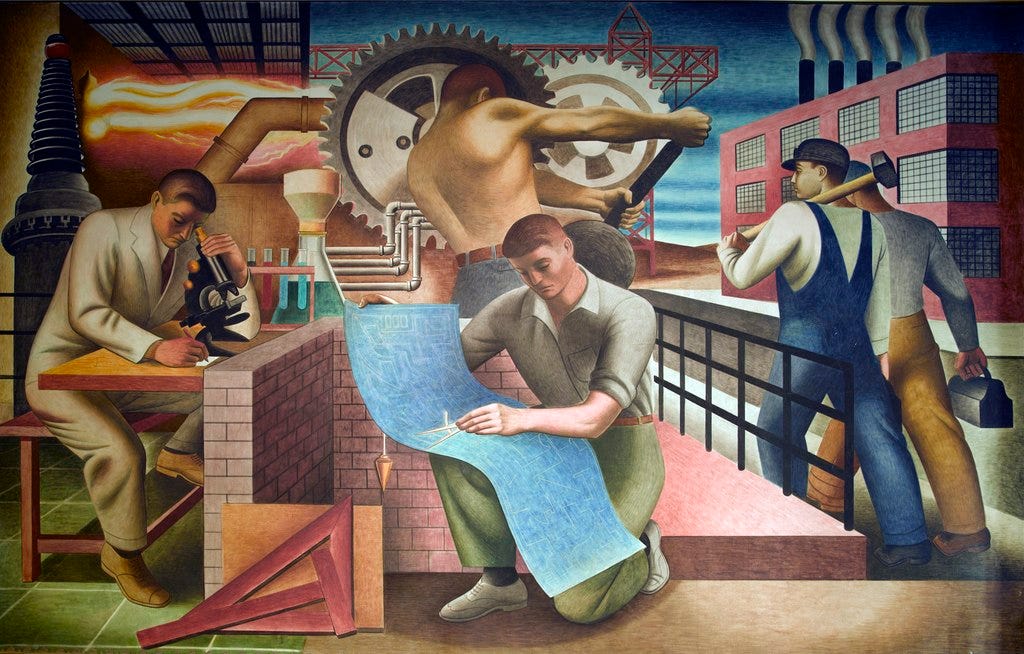
The architect and the bee
Karl Marx understood the universal nature of creativity. In a well-known passage from Capital Volume I, he uses the examples of the architect and the bee to show what is distinctive about human labor:
A spider conducts operations that resemble those of a weaver, and a bee puts to shame many an architect in the construction of her cells. But what distinguishes the worst architect from the best of bees is this, that the architect raises his structure in imagination before he erects it in reality.
What differentiates human from animal labor is not creativity: both the spider and the bee are creative because they make something from nothing. In fact, they do these tasks so well that they put humans “to shame”; if you’ve seen the work of an eagle’s nest resist gale-force winds, or a beaver’s dam alter entire ecosystems, it’s hard to doubt the creative abilities of animals.
For Marx, the key difference is the use of imagination, or design. The Latin root of design is designare meaning to “mark out.” Using their unique abilities to plan things ahead of time, humans have learned to create schematics of complex assemblies that don’t yet exist. While the eagle builds her nest stick by stick through instinct, the human imagines their design, and the instructions for its assembly, before creating it.
Exploiting creativity
If to create is to make something from nothing, and to design is to plan it ahead of time, then all human labor contains both, to different degrees. A worker cleaning after working on assembly line “produces” both a product and a different kind of space that requires a small but meaningful amount of foresight. And an architect creates designs in the form of drawings that are both “products” themselves and necessary steps to making the future building.
But what happens when an ability that defines all human labor - creativity - becomes a narrow identity? Believing that they are uniquely creative, design workers generate a false identity, or consciousness, which conceals the fact that they experience the same kind of exploitation that all wage workers face. In this way, creativity as identity is at the center of exploitation of design workers like architects.
A key concept from Marx can help us understand how this false identity is exploited: the theory of surplus value. The worker must not only generate enough value for the owner to pay a wage for their labor, but also additional profits, or surplus value, for the owner.
Just like profits, ideas are also generated during the working day. This is especially
important in design industries, as their main product is a design. It is typical for the boss to ask for the best idea possible in order to realize the best design possible. Because the benchmark for this standard is murky at best, the process usually translates to iterating an exhaustive list of ideas.
It costs nothing to ask professional, salaried workers for more hours of labor. At the end of this process, when the building or product is finally made, it is never the worker who gets credit, but the owner. This is just one example of how certain “design principles” not only exploit workers by generating “surplus ideas” from them, but encourage them to enforce their own exploitation.
From self-exploitation to solidarity
Attachment to this false identity is preventing design workers from organizing to improve their profession. Facing a general degradation of the labor force that is now catching up to them, workers in my industry - architecture - are seeing lower wages, longer hours, and generally worse conditions. This degradation is now threatening the “middle class lifestyle” that professions have historically promised.
But once they pierce the veil of creativity-as-identity, it is possible to see that they have much more in common with other workers than what sets them apart. Were they to realise this commonality, they would approach their work with a new-found solidarity, perhaps even joining other workers in the struggle to build working class power.

I think a lot of the analysis of capitalism from various perspectives misses a key point - most people, even workers, even *unionised* workers - don't see much wrong with the central idea of creating surplus value to sustain a managerial class or even to sustain corporate profits.
But equally, I would contend that the vast majority of workers (of all types) have a very keen sense of when that *consensual* exploitation goes too far.
In simple, and scatalogical, terms, it's ok as long as capital doesn't take the piss. The groundswell against neoliberal capitalism now is that it takes the piss almost all the time, whilst trying to reframe the bargain as being if anything, over-generous and there being too much "dead wood", that there's a need to "trim the fat" or various other euphemism for further urine extraction.
The self-exploitation of creative workers is real.