
JPMorgan economists have found that just 30 AI stocks have added around $5.2 trillion to U.S. household wealth over the past year. This increase in household wealth has driven an estimated $180 billion in additional annual consumer spending. Remember, this isn’t the spending of the big tech companies themselves – this is just the consumption of households who have invested in the AI boom.
Financial wealth – such as investment in AI stocks – is concentrated among the wealthiest households. While the proportion of households that own stocks has risen to a record high of 58%, that doesn’t mean that the gains from the stock market boom have been equally distributed. Rather, the wealthiest 10% Americans hold around 93% of the country’s stock market wealth.
When you put these two stats together, everything about the US economy starts making sense. I wrote a piece a few weeks ago on how households in the top 10% of the income distribution now account for half of all consumer spending in the United States. That top 10% also holds the vast majority of stocks. And the wealth derived from those stocks is driving an extra $180bn in consumer spending. In other words, the AI boom is driving the consumption of the rich – and the consumption of the rich (plus the investment of the big tech companies) is driving the whole economy.
This is exactly what happened before the financial crisis. Financial deregulation drove a lending boom, which pushed up house prices. Those who owned homes felt wealthier, and started spending more money - the so-called ‘wealth effect’. Some financial institutions even allowed you to borrow against the value of your home to finance current spending. The difference between the wealth effect then and the wealth effect today is that housing is much more evenly distributed than stocks. The housing bubble drove a spending spree for the middle classes - the AI boom is just driving a spending spree for the rich.
The US economy has become one big bet on AI. It’s not just that investment in AI has led to the the emergence of a bubble – it’s that the bubble is driving wealth inequality, and billions of dollars of conspicuous consumption. In other words, we’re living in a new gilded age.
Wealth for Some, Debt for Others
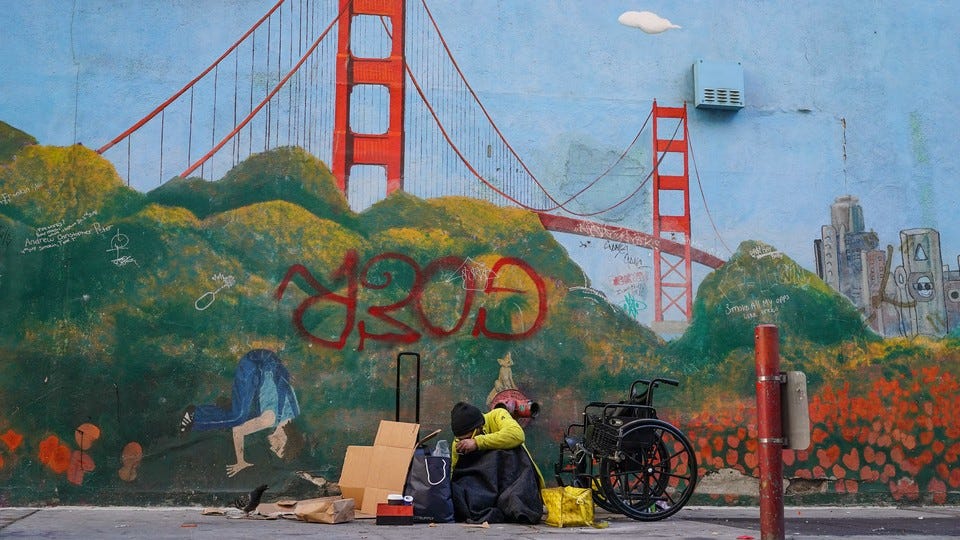
This insight helps to explain what seems like a contradiction in the US economy: consumer spending remains strong, even as metrics like consumer confidence and employment weaken. Things are going well for the rich, and not so great for everyone else. High earners are spending like the bubble will never burst. Those on lower incomes, meanwhile, are still struggling with an ongoing cost of living crisis and stagnant wages.
The result is an economy that looks deceptively resilient from the top down – but which shows signs of weakness as soon as you look below the surface. A recent poll found that a third of Americans said their financial situation had deteriorated over the course of the past year. The same poll showed that 45% Americans say that the cost of living in their area isn’t affordable, and 30% say their monthly expenditure exceeds their monthly income. That difference is being covered by debt, with consumer debt figures rising year on year. Credit card debt, in particular, has soared in recent years.
The rise in credit card debt is particularly concerning because its unsecured debt – it’s not backed up by an asset. When you borrow to take out a mortgage, you’re borrowing against the value of the house. Even student borrowing can be thought of as borrowing against the value of the degree – the amount it is likely to increase your earnings over your lifetime. But credit card debt is just borrowing against future income – and if your income is stagnant, that debt is just going to keep piling up.
At the moment, consumer debt isn’t a threat to financial stability. But the levels of borrowing at the lower end of the income spectrum are concerning because if the US ends up in recession, people will lose their jobs, and many won’t be able to pay their debts. The banks will be fine, but some people will lose everything, and many more could find themselves locked out of credit markets and pushed even deeper into poverty.
When the Bubble Bursts…
The US economy is just so astonishingly imbalanced right now, it’s starting to look like it did in the late 1920s. Then, a huge stock market crash led to a deep economic crisis – a crisis so bad that it forced a rewriting of the rules of the entire economy. I don’t think we’re heading towards another Great Depression – but I do think we’re headed for a big economic meltdown, which is going to harm the poor much more than the rich, and potentially force another rewriting of the economic rules.
I’ve written a lot about the bubbles in both AI and private credit, which are increasingly interlinked. At some point – maybe in 6 months, maybe not for 2 years – the bubble will burst, and everyone will start frantically trying to get their money back. Not everyone will be able to get their money back. This will trigger a deflationary shock, in which asset prices fall – by how much is anyone’s guess. Governments will do their best to mitigate the impact of this shock through another round of bailouts designed to protect the fortunes of the rich.
Lots of people are comparing the AI bubble to the dot-com bubble, but the effects of an AI crash on the real economy will be even more significant. There’s just not much going on in the US economy outside of AI investment and the spending of the wealthy, which is driven by AI investment. One Harvard economist estimated that, without investment in data centres, US GDP growth would have been 0.1% in the first half of the year. And that’s just data centres. When these sources of demand dry up once the bubble bursts, the US economy will find itself deep in recession – and dealing with a financial crisis to boot.
Meanwhile, working class Americans will lose their jobs, default on their loans, and many will find themselves pushed into abject poverty. When their corrupt, oligarchic government once again rides in to rescue the rich, there is going to be hell to pay.
How many more times are we going to allow this to happen though? Living standards are dropping and dropping and Marxism is still seen as a joke.
Thank you very much for this article of perspective. It will all be a matter of timing to make a bit of cash when the bubble does burst. But we all know bubbles can exist for much longer as one is liquid.
Let's hope the end of this New Gilded Age will come before Trump 2.0 is getting ready for Trump 3.0! The parallels to the late 1890's are quite interesting though.