Is the AI Bubble about to Burst?
Probably - but that doesn't mean the end of the boom.

Ever since the pandemic, the American stock market has been booming.
The S&P 500 reached record highs a few times over the course of 2024. The index has delivered returns of more than 20% for the last 2 years in a row – only the second time such a performance has been recorded since the 1920s. And the tech-dominated NASDAQ 100 has nearly doubled since the start of 2023.

The strong performance of US stock markets is, in part, due to the apparent strength of the US economy. The economy grew by a robust 2.5% in 2023, followed by an expected 2.9% in 2024, and unemployment is low and stable.
Strong employment data indicates high business confidence, which typically leads to increased investment. This investment creates demand for other businesses in the supply chain, boosting profits.
This cycle is the reason that positive economic data often leads to increased stock prices. When businesses are hiring and the economy is expanding, investors believe that profits will increase in the future.
The key term here is ‘believe’. What investors are thinking and feeling is, in many ways, more important than the actual economic data (though the two are closely linked).
High investor confidence can lead to a cycle of optimism-induced growth: rising share prices boost corporate optimism, prompting more hiring, which in turn supports higher share prices.
Eventually, this self-reinforcing cycle can lead to financial market valuations that are too high – in other words, a bubble.
Boom and Bust
The value of a share is based on investors' expectations about future profits. An increase in the value of a share suggests that investors anticipate higher profitability for the company in the future.
But sometimes, a share's value becomes so inflated that it no longer reflects the company's expected future profitability.
When investors start buying up a share expecting its value to increase, they drive up the price, vindicating their own expectations and encouraging more investors to pile in. When this dynamic applies to a whole group of shares, you’ve got yourself a bubble.
This cycle can continue for a very long time. Even when investors know that they’re witnessing a bubble, for as long as share prices are rising, there’s an incentive to get in on the action. Bubbles work a bit like Ponzi schemes – you can make lots of money as long as you’re not the last one in the door.
Speculation-driven bubbles cause instability. Everyone is watching out for a sign the bubble is going to burst – anything from a bad jobs or earnings report, to a policy change, to a war. Investors are just waiting for the ball to drop so they can hit ‘sell’ before everyone else does.
When the signal to sell appears, the cycle reverses. Share prices decrease, prompting investors to sell their shares, which further lowers share prices.
Smart investors know roughly what a share’s value should be, based on an assessment of the firm’s assets, its past profits, and its corporate governance. They wait for the market to bottom out before buying up good shares on the cheap.
This is exactly what happened with the tech bubble of the late 1990s. Most investors knew there were a lot of poorly-run tech companies out there that were highly overvalued – they were just waiting for the ball to drop.
Jitters started to spread in March 2000, with the news that Japan had entered recession. A few weeks later, Microsoft lost an antitrust case, leading to a 15% fall in its share price. Rumours began to swirl about poor management and unsustainable spending among a few tech companies.
Share prices collapsed, and a few companies went under. When the storm had passed, it became clear that a few of these companies had been engaged in some pretty creative accounting practices, if not outright fraud. But if you knew where to look, you could pick up some strong shares at bargain prices.
The Magnificent 7
The boom and bust cycle becomes even more pronounced when financial markets are highly reliant on a few superstar stocks. And that’s exactly what’s going on right now.
The gains in most major indices have been driven by the so-called ‘magnificent 7’ tech stocks. Chip maker Nvidia has delivered returns of over 3,000% over the last five years. Tesla has seen 1,200% growth, and Apple, Meta, Alphabet, Amazon, and Microsoft have all seen gains of more than 100%.
The substantial returns generated by the big companies have obscured the very average performance of firms in other sectors. These high returns have also driven historic levels of concentration in financial markets.
The top 10 companies now account for 37.3% of the S&P 500 – the highest concentration in history. 26 stocks now account for half of the value of the entire index. Apple, Nvidia, and Microsoft account of 13% of the value of the S&P on their own.
Investors have justified the high valuations for the big tech companies with reference to the potentially revolutionary economic impact of AI. Many Magnificent 7 companies have invested vast sums in developing AI technologies, and Nvidia provides the chips that support this growth.
But today, investors are starting to question the viability of these investments. AI technology might be revolutionary, but is it going to generate superstar profits to match current superstar valuations?
Back to the 90s
The tech bubble provides a good parallel. In the 1990s, investors were so caught up with the excitement surrounding the growth of the internet that they funnelled their cash in any company with an online presence – from Microsoft, to Pets.com.
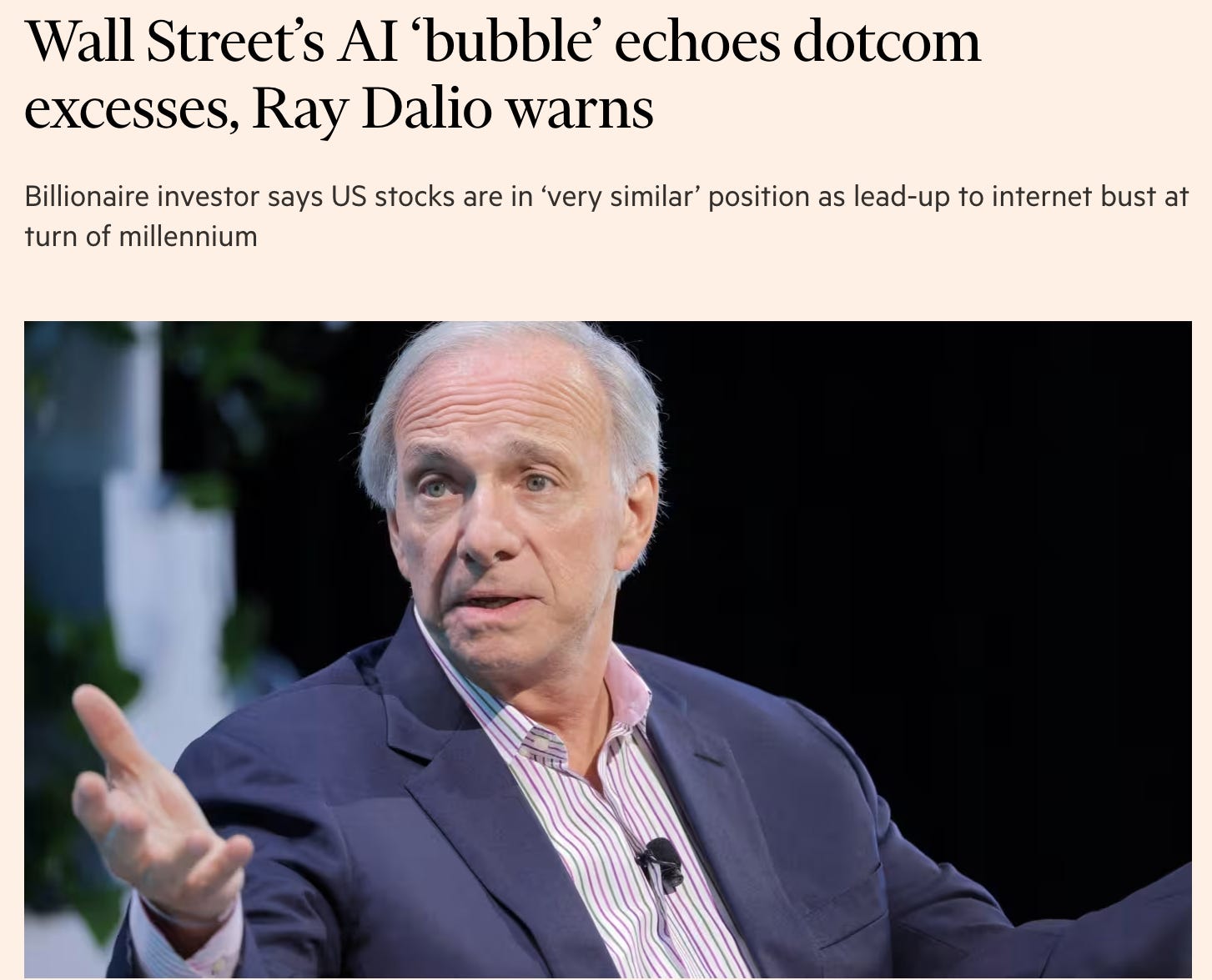
The bubble didn’t burst because investors suddenly realized the technology was useless. It burst when it became clear that some companies couldn't sustainably profit from their investments. Microsoft survived the tech bubble, but Pets.com collapsed.
The same is true for AI. The technology is probably going to transform the global economy, but that doesn’t mean all the AI investment undertaken up to now is going to be profitable.
When the tech bubble burst, many investors lost money, but the economy didn't collapse. Some even profited – it was ordinary retail investors who suffered the most.
We’re looking at a similar situation today. The AI bubble will probably burst in a few years. Investors are already jittery. There was a big panic-induced sell off when Chinese company Deepseek announced an AI breakthrough. It’s not going to take much to tip the scale from confidence to fear.
This doesn’t mean the end of the AI boom; any more than the tech bubble meant the end of the internet boom. It just means that some people are set to lose quite a bit of money – though probably not the wealthiest investors.
"The bubble didn’t burst because investors suddenly realized the technology was useless. It burst when it became clear that some companies couldn't sustainably profit from their investments."
Could one ever be forgiven for concluding that: global finance capital has become little more than having the wit to thrive within an historically almighty scam?
The AI bubble may burst—but the deeper story is older than this market cycle.
When technology becomes a proxy for power, its purpose shifts: not to liberate, but to extract. The machines aren’t the problem. The owners are.
Capital sees only tools and profit. The pattern must change—not just what we build, but who it’s for, and who decides.