Generation Despair
Work doesn’t pay, housing is out of reach, and life has been enshittified — why should young people keep propping up a system rigged against them?

For decades, capitalism in Britain has survived on the basis of an implicit inter-generational bargain. Work hard, keep your head down, and eventually you’ll be rewarded with a decent standard of living. That bargain has collapsed. And young people know it.
Young people today can see very clearly that, no matter how hard they work, they will never live the comfortable lives their parents took for granted. The ladder has been kicked away; its rungs – a solid welfare state, strong workers’ rights, and a functional housing market – have snapped.
Our political class, most of whom grew up in a world where these things were taken for granted, refuse to acknowledge what a mess our economy has become for young people. Rather than fixing the problems they’re facing, Labour is instead lecturing young people about the value of hard work.
Over the weekend, Labour announced a new policy whereby young people will lose their social security payments if they fail to take a job after 18 months without work. To make matters worse, the government will be paying private businesses to employ these out of work young people – a huge corporate subsidy that will enrich private shareholders by facilitating the exploitation of young workers.
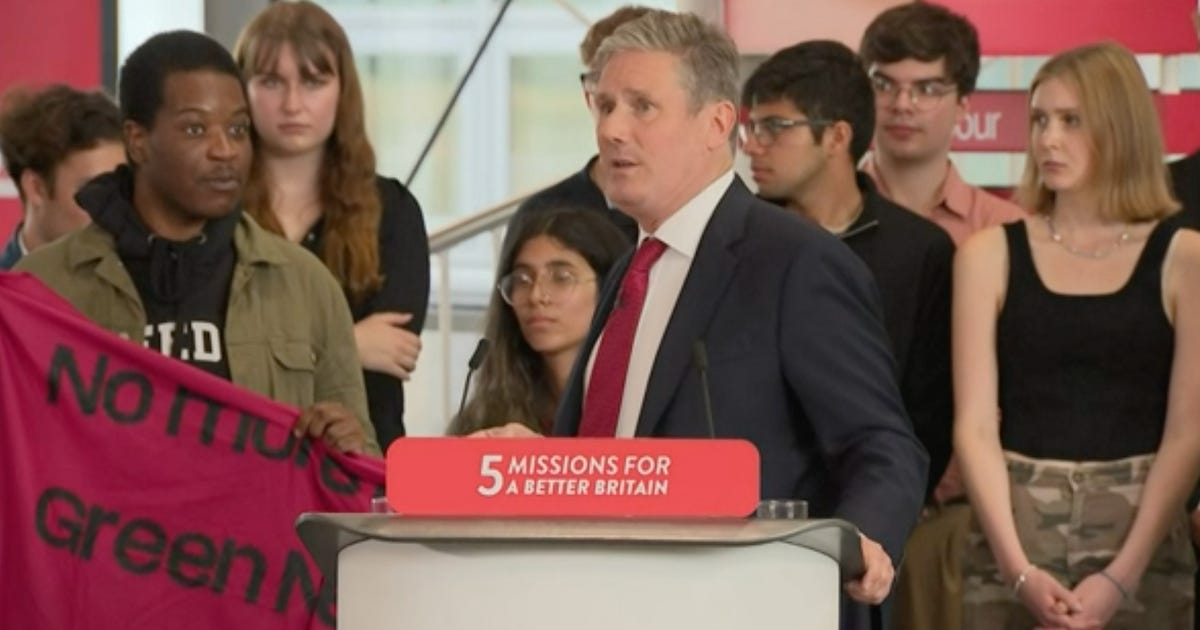
Is it any wonder that support for Labour has collapsed among young people? The Greens are by far the most popular party among young people as a whole. And Keir Starmer’s response is to call the party ‘nuts’ for advocating an anti-landlord policy extremely popular among young voters. It’s almost as though he’s trying to alienate them.
But the issue goes deeper than Starmer’s unpopularity. The problem is that young people don’t have any reason to participate in an economy that’s rigged against them. And Labour is too busy listening to the City and the CBI to do anything about it.
Work No Longer Pays – but Wealth Does
Starmer and Reeves are constantly talking about the need to “make work pay”. To their credit, they have increased the minimum wage. But this change is of little help to more than a million people on zero hour contracts. Many businesses have already said they’ll respond to the increase in the minimum wage by offering less work, which is pretty easy when your staff don’t have contracts with guaranteed hours.
Labour market “flexibility” has gone way too far. Zero-hour contracts are baked into our economic model. Workers are left waiting by the phone for shifts that may or may not come, unable to plan their lives, their finances, or even their meals. It’s a system defined by precarity, and a system Labour promised to end.
But instead of abolishing exploitative zero-hours contracts, Labour once again backed down. As I’ve argued before, we’re living in a system of government-by-lobbyists, and corporate lobby groups like the CBI demanded that Labour amend their workers’ rights bill to end talk of a ban on zero hours contracts. Ignoring protests from the labour movement, the Party obeyed. The country has been left with a labour market in which insecurity is the norm; and young people are the ones paying the price.
The inverse of all this worker exploitation is, of course, extraordinary profits for those at the top. Jeff Bezos is only one of the wealthiest men in the world because Amazon offers its workers zero-hour contracts that pay meagre wages and impose horrendous conditions, while forcefully denying them the opportunity to unionise. The wealth of the billionaire class is the flipside of the immiseration of the working class.
The Property Ladder Has Snapped in Half
But it’s not just that work doesn’t pay and workers’ rights have been curtailed. Even if you do earn what would once have been considered a good wage, it’s not enough to purchase the basic things you need to survive. For many, it’s not even enough to keep a roof over their heads.
Reeves’ and Starmer’s generation benefitted from cheap credit and a giant, global housing bubble that ensured homeowners saw the value of their properties double, or even triple, over the course of their working lives. The generation before theirs benefitted from cheap and readily available social housing. Our generation has neither.
Most young people are forced to choose between paying half of their salary to a dodgy landlord for the pleasure of sharing a dingy property with several other people or continuing to live with their parents. The idea of home as a space of stability and autonomy has been replaced with endless moves, mould, and landlords who treat their tenants as sources of ‘passive income’ rather than human beings.
Even those lucky enough to save up a deposit, or to be given one by their parents, won’t see the same astronomical increase in their housing wealth taken for granted by their parents. As I wrote in a post a few months ago, the housing bubble was a once in a generation event catalysed by an extraordinary explosion of credit, which can never be repeated.
The bubble ended with the financial crisis, and the government attempted to restart it with extreme loosening of monetary policy. But now, in the era of high inflation, and therefore high interest rates, that option is no longer available. You cannot repeat a once-in-a-century credit boom when both interest rates and debt levels are structurally higher.
The Enshittification of Everyday Life
If low pay and insecure housing weren’t enough, the basic fabric of life in the UK has been systematically degraded. Our IRL lives have been subjected to the same process that has degraded our experience online: enshittification.
Austerity utterly broke the fabric that held us together as a society. Public services are struggling to meet demand. Councils are going bankrupt. Youth centres, libraries, and community hubs – the places where young people once built networks, skills, and friendships – have been shut down.
The post-pandemic inflationary crisis was the nail in the coffin for liveability in the UK. With the cost of living so high, some people are working so hard that they don’t have the time for hobbies they used to enjoy together, while others simply can’t afford to go out at all. Even accessing nature increasingly requires a car or an entry fee.
Instead, more and more people are forced to stay at home when they’re not at work, scrolling, trying to numb the sense that something has gone deeply wrong. They’re not lazy; they’re just hopeless. And when people feel hopeless they naturally retreat from economic life. Some are opting to leave the country altogether.
A Generation with Nothing to Lose
Add all these factors up and it becomes much easier to see why young people aren’t working as much as their parents did. Economic participation has become trap, leaving people stuck between low pay, astronomical housing costs, collapsing public services, and the disappearance of meaningful social connection. And this trap is driving a crisis of despair so deep that it is reshaping the labour market.
Nearly a million young people in the UK are so-called Neets (not in employment, education, or training). Many more are stuck living with their parents working zero-hour contracts that pay them barely enough to get by. And even those in work, earning good money, despair for the future because they know that they will never stop worrying about the cost of living.
The Labour Party’s response is to blame these young people for being ‘workshy’. But why should they get up and go to work every day when our economic model offers them so little? Why take on the stress of an exploitative job, with no security and no future, when you can live with parents or relatives, work part-time, and avoid being crushed by a system rigged against you? Why continue to participate in society when you have no hope for the future?
Asking these questions does not make you lazy or irresponsible. Asking these questions is a rational response to an economy that does not work in your interests.
A political class that responds to this crisis of despair with derision or blame does not merit the support of young people. Unless Labour can offer a compelling answer to the question ‘what do I have to be hopeful for?’, they don’t deserve to govern. Thankfully, with Zack Polanski leading Green Party, there’s finally another option – and young people have been the first to take it.
There are one or two of us old folk who joined The Zach Greens as well. Some of us do care but other than casting a vote, it is very hard to right all the wrongs.
Another insightful and eloquent piece. All power to your elbow.