We didn't choose AI. Capital did.
The AI boom was planned by capital. When it collapses, capital must be made to pay.

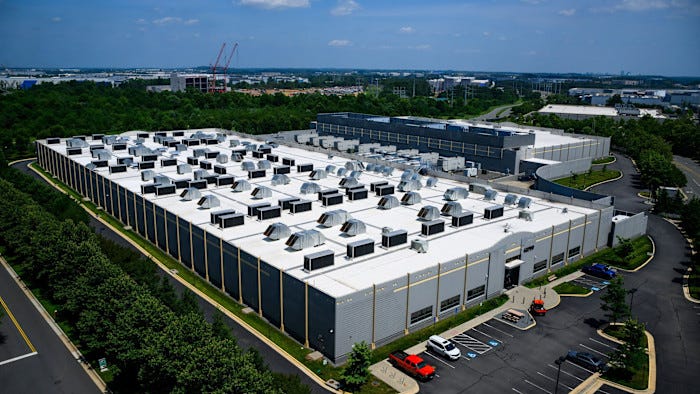
The big tech companies have spent $1 trillion on capital investment since the start of the AI boom. Pretty much all that investment has been used to build data centres, purchase the chips that power those data centres, and construct the energy systems that fuel and cool them.
That $1 trillion could have been used for anything. It could have been invested in renewables. It could have been used to develop life-saving new drugs. It could have been used to build housing, public infrastructure, or anything else human beings need to survive and thrive.
Instead, it has been channelled into constructing energy-draining, water-absorbing data centres that power LLMs built on the theft of millions of people’s creative work, which consistently produce incorrect responses and drive many users mad in the process. It’s hard to think of a worse use of society’s shared resources.
Now, you may argue that we live in free market societies, so investment takes place according to the laws of the market. All that money and investment is flowing into AI because it is simply the most profitable use of resources. And when society maximises profits, it maximises efficiency – ensuring that, on aggregate, everyone is better off over the long run.
There are a lot of problems with this story. Firstly, we do not live in free market societies. We live in capitalist societies – that is, societies dominated by capital. Capital is not distributed into lots of little businesses each producing widgets in perfect competition with one another. Capital agglomerates until it is concentrated within a few massive, monopolistic corporations, controlled by a few powerful men.
These massive corporations can afford to ignore what’s profitable in the short run pursuit of what will bring their owners immense wealth and power in the long run. Just take Amazon. It was unprofitable for years while Jeff Bezos channelled more and more money into expansion. Investors continued to funnel billions into Amazon’s coffers because they were betting that Bezos could carve out a powerful monopoly. And they were right. Corporate concentration and monopoly power trump competition and efficiency every time.
Despite all the hype about AI, LLMs are not currently profitable. OpenAI and Anthropic – the two companies whose fate is tied entirely to the performance of their LLMs – have yet to make a profit. And yet both companies are trying to list on the stock market chasing valuations of $1 trillion.
Why? Because these two companies have successfully enclosed – that is, taken and put walls around – vast areas of human knowledge. Now, they are selling this knowledge back to us in the form of strange, sycophantic chatbots that put all this knowledge back together in unpredictable – and sometimes completely useless – ways. Still, investors are betting that this innovation will revolutionise capitalist production, and that one or both of these companies will continue to hold immense power over the market.
All the other companies in the ecosystem – the ones building the infrastructure, the ones producing the chips, the ones powering the data centres – are dependent upon the performance of the LLMs at the centre of the boom. Which is why companies like Nvidia and Oracle are locked into a circular network of financing with OpenAI – they’re funding OpenAI while it loses money, because their profits are contingent upon the company’s success.
This is where the next correction to our original story comes in. Right now, we are absolutely in a bubble when it comes to AI. That doesn’t mean the technology won’t permanently change the way our economy works – but it does mean that the tech won’t be as profitable as most investors are expecting, especially over the short term. In other words, not only are our markets not free – they’re not efficient either.
Investors are betting that this tech cycle will be like the last one – the one where companies like Google, Meta, and Amazon enclosed the entire internet. Lots of those companies took a long time to make any profit, because they were investing to eke out a market-dominating position – not to maximise short-term profits. The companies involved in the AI boom are trying to do the same thing – but it’s not working.
First, there’s too much competition among US LLM providers. It’s not just ChatGPT and Claude now – Gemini and Copilot are nipping at their heels. Then, there’s competition from China. Chinese companies have already been able to create their own LLMs – they might not be as good as the originals, but it doesn’t matter, because they’re incredibly cheap.
And then there’s the productivity puzzle. For the LLMs to be profitable over the long run, they need to be rolled out by lots of businesses that won’t cancel their subscriptions as soon as a cheaper option is available – which means the productivity gains of introducing the technology have to be very clear. But not many businesses have seen significant productivity gains from the introduction of the technology. In this context, it’s not clear how all these LLMs are going to generate the profits required to produce a decent return on that $1 trillion investment.
When investors realise that some of the bets they have made aren’t going to yield much of a return, the cash will dry up. The circular webs of financing will collapse. Companies will go under. And the world will be left with hundreds of massive data centres without enough customers. Compute will become extremely cheap – just like accessing the internet did after the telecoms companies spent billions competing to lay fibre optic cables in the 1990s.
The boom will get going again after the bust – with valuations returning to more sensible levels. A few of the massive tech companies will buy up the remnants of the others, leaving the market even more concentrated. The technology will become pedestrian as it is incorporated into every area of our lives. People will get real about what AI can do, and what it can’t do.
Of course, millions of people will lose their jobs and their savings during the bust. Wealth and power will become even more concentrated, as the largest tech companies buy up their defunct competitors, before leveraging their control over the technological infrastructure that most other businesses require to function. They will use this power to further capture our democracies, lobbying politicians to wage war on their foreign competition.
Our environment will also be permanently changed. Erald Kolasi and Jesse Damiani have just written an excellent piece calculating the environmental impact of the AI boom. They estimate that, in 2026, AI will be responsible for 1.1% of total global energy demand. AI is already using more energy than the whole of the United Kingdom. Meanwhile, many communities are being forced to go without water, while others experience striking ‘heat island’ effects from the astonishing amounts of heat being pumped out by these megaliths.
After years of hype, and trillions of dollars, the AI boom will leave us with a captured economy, a corrupted democracy, and a devastated environment. We’ll be told that this is just how markets work – sometimes they go up, sometimes they go down. But this narrative obscures how decisions are really made in capitalist economies.
As I showed in my book, Vulture Capitalism, capitalist economies are characterised by pervasive central planning. Monopolistic corporations work with corrupt politicians to decide who gets what, while using ‘the market’ as a veil to conceal their power. The AI boom is no different. A few powerful capitalists decided that we would spend several years devoting all our time and money towards the development and roll out of AI – and so we did.
‘The market’ didn’t decide that AI would be our future. Capital did. And when the devastating consequences of their decisions become clear, we cannot allow them to hide behind disembodied market forces. Capital took us down this route, and capital must be made to pay. The politicians aren’t going to go after their wealthy backers – that part is on us. So block new data centres, strip them for parts, and start organising your communities and your workplaces for the fight back.
AI is both a speculative bubble and a tool to discipline labour. No wonder over $1 trillion was found. If only we had a socio-economic system optimised for a liveable planet.
Hopefully AI takes down capitalism with it